A powerful connection you might be overlooking
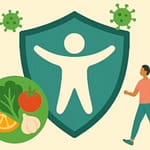
Every day, your immune system is working silently — stopping viruses before they make you sick, repairing tiny damages in your body, and learning to recognize new threats. But here’s something most people don’t realize: much of this “immune training” doesn’t happen in your blood. It happens in your gut.
Inside your digestive tract lives a complex ecosystem of trillions of microbes — bacteria, fungi, and other microscopic life — weighing roughly as much as your brain. This community, called the gut microbiome, is directly connected to up to 80% of your immune cells (Wiertsema et al., 2021).
When your gut microbiome is balanced and diverse, it helps your immune system respond quickly to harmful invaders and ignore harmless triggers. When it’s out of balance, your defenses can become weaker, or overreact, leading to inflammation and illness.
One of the easiest ways to care for this system? Adding fermented foods to your daily diet.
Why fermented foods stand out
Fermentation is a natural process where beneficial microbes break down food, making it more nutritious and easier to digest. The benefits include:
- Probiotics — live bacteria that join and support your gut’s existing community.
- Bioactive compounds — like short-chain fatty acids that help regulate inflammation.
- Enhanced nutrients — fermentation can make vitamins and minerals more available to your body.
Common examples: yogurt, kefir, sauerkraut, kimchi, miso, tempeh, and certain pickles. The key is that they must contain live and active cultures when you eat them.
What research says
While many cultures have relied on fermented foods for centuries, modern science is now confirming their benefits:
- A 10-week randomized controlled trial at Stanford found that eating fermented foods daily increased microbiome diversity and reduced several inflammatory markers (Wastyk et al., 2021).
- A study in older adults showed that a probiotic dairy drink improved their antibody response to flu vaccination (Boge et al., 2009).
- A systematic review found that some probiotic strains can improve vaccine effectiveness by increasing antibody levels (Lei et al., 2017).
This means fermented foods can play a role not just in digestion, but in how well your immune system responds to challenges (further reading: How Zinc Strengthens the Immune System: History, Science, and Practical Ways to Stay Protected).
How to add them to your day
You don’t need to overhaul your meals. Start small and build up:
- Breakfast — Add plain yogurt with fresh fruit.
- Lunch — Include a side of sauerkraut or kimchi in a sandwich or salad.
- Snack — Drink a glass of kefir.
- Dinner — Try tempeh in a stir-fry or miso soup as a starter.
A good starting point is one serving per day. Increase gradually to let your gut adjust.
Smart shopping tips
- Look for “live and active cultures” on the label.
- Choose refrigerated products — shelf-stable versions are often pasteurized, which kills probiotics.
- Avoid high-sugar options in yogurt or kefir.
- Check sodium levels in fermented vegetables if you monitor salt intake.
A 7-day challenge to boost your gut
Day 1: Yogurt with berries at breakfast.
Day 2: Kimchi on scrambled eggs.
Day 3: Kefir smoothie with banana.
Day 4: Sauerkraut in a salad.
Day 5: Tempeh stir-fry.
Day 6: Miso soup before dinner.
Day 7: Repeat your favorite from the week.
The bottom line
Your gut isn’t just about digestion — it’s a key player in your immune system. By adding a small portion of fermented foods each day, you can support your body’s natural defenses in a simple, affordable, and delicious way (you might also like: How Zinc Strengthens the Immune System: History, Science, and Practical Ways to Stay Protected).
References
- Wiertsema, S. P., van Bergenhenegouwen, J., Garssen, J., & Knippels, L. M. J. (2021). The Interplay between the Gut Microbiome and the Immune System… Nutrients, 13(3), 886. https://doi.org/10.3390/nu13030886
- Wastyk, H. C., Fragiadakis, G. K., Perelman, D., et al. (2021). Gut-microbiota-targeted diets modulate human immune status. Cell, 184(16), 4137–4153.e14. https://doi.org/10.1016/j.cell.2021.06.019
- Boge, T., Rémigy, M., Vaudaine, S., et al. (2009). A probiotic fermented dairy drink improves antibody response to influenza vaccination in the elderly in two RCTs. Vaccine, 27(41), 5677–5684. https://doi.org/10.1016/j.vaccine.2009.06.094
- Lei, W.-T., Shih, P.-C., Liu, S.-J., Lin, C.-Y., & Yeh, T.-L. (2017). Effect of probiotics and prebiotics on immune response to influenza vaccination in adults: A systematic review and meta-analysis. Nutrients, 9(11), 1175. https://doi.org/10.3390/nu9111175