A guide to building a daily hydration habit that supports steady energy, clearer focus, emotional balance, and long-term health.
Hydration is one of the most underestimated foundations of well-being. While many people track steps, macros, or exercise minutes, very few consistently track how much water they drink—despite hydration influencing nearly every biological system. Research across physiology, nutrition, neuroscience, and behavioral science shows that hydration is not merely about avoiding dehydration; it is a daily biological investment that supports resilience, focus, metabolic efficiency, and emotional balance (Riebl & Davy, 2013).
This expanded guide explores the origins of hydration science, how water interacts with body systems, the psychological and behavioral drivers of hydration habits, and detailed steps for building a sustainable, lifelong drinking routine.
The History: How Science Discovered the Power of Hydration
Although humans have always known that water is essential, scientific understanding developed slowly.
1. Early Observations (1850–1950)
Physiologists first documented the role of water in blood pressure, temperature regulation, and sweat loss. Early military and labor research—such as studies on miners and soldiers working in heat—revealed that even modest dehydration caused fatigue, poor concentration, and impaired physical performance.
2. Modern Hydration Science (1980–2000)
With advancements in biochemical measurement, researchers discovered:
- Dehydration affects electrochemical gradients in neurons.
- Cognitive decline begins earlier than previously thought (sometimes at 1–2% body mass loss).
- Body water is tightly linked to glucose regulation and thermoregulation.
3. Current Research (2000–today)
Today, advanced brain imaging and hormone analysis reveal:
- Hydration affects cortisol and stress regulation (Masento et al., 2014).
- Water intake influences cognitive processes such as attention, working memory, and mood (Adan, 2012; Ganio et al., 2011).
- Chronic low hydration might play a role in long-term kidney and cardiovascular health (Kenney, 2004).
Hydration research is no longer viewed as niche physiology. It is central to preventive health.
The Physiology: What Hydration Does Inside Your Body
Hydration influences nearly every biological system. Here is a deeper look:
1. Blood Volume and Circulation
Water maintains plasma volume. When you are dehydrated:
- Blood becomes more concentrated.
- The heart must work harder.
- Oxygen transport is less efficient.
This means daily tasks feel more tiring—even before you feel thirsty.
2. Brain Function and Mood Regulation
The brain is ~75% water. Studies show that dehydration affects:
- Neuronal firing rates
- Memory consolidation
- Mood stability
- Neurotransmitter balance
He et al. (2020) found that regular hydration throughout the day—not simply total volume—supports better mood and working memory.
Zhang et al. (2021) demonstrated that mild dehydration increased fatigue, tension, and anxiety-like symptoms.
3. Metabolism, Appetite, and Weight Regulation
Adequate hydration:
- Improves mitochondrial efficiency
- Supports glucose transport
- Helps regulate appetite, as many people confuse thirst with hunger
One reason hydration supports metabolic health is its role in cellular signaling pathways that govern energy availability.
4. Detoxification and Kidney Function
Your kidneys filter ~150 liters of blood daily. Without adequate water:
- Waste products accumulate
- Kidney stone risk increases
- Electrolyte balance becomes unstable
This highlights why consistent hydration is essential for long-term organ health—not merely short-term performance.
5. Hormonal Regulation and Stress
Studies show that inadequate hydration increases cortisol levels and can worsen stress responses in daily life (Masento et al., 2014).
Hydration is, therefore, not only physical—it is emotional and neurological.
The Psychology: Why We Forget to Drink Water
Hydration is not hard, but remembering to hydrate is. Behavioral science explains why.
1. Thirst Is Not a Reliable Signal
Research demonstrates that thirst often appears later than your actual biological need (Adan, 2012).
This is especially true in:
- Older adults
- Busy professionals
- Children
- People in air-conditioned or cold environments
2. Hydration Isn’t a Rewarding Behavior
Drinking water does not trigger dopamine in the same way as coffee or snacks. So the brain does not label hydration as a “reward”—making consistency harder.
3. Environmental Distraction
Most hydration failures occur during:
- Work or study
- Long meetings
- Driving
- Screen time
Because these activities occupy mental space, hydration becomes an afterthought.
4. Behavioral Inertia
According to habit formation research (Singh et al., 2024), it is easier to continue a behavior you already do than to start a new one.
This means the key is not motivation—it is reducing friction.
How Much Water Your Body Actually Needs
The popular “8 glasses a day” is a simplified guideline.
The Institute of Medicine provides more accurate reference values:
- Men: ~3.7 liters/day
- Women: ~2.7 liters/day
Inclusive of all beverages and food (Institute of Medicine, 2004).
But needs vary based on:
- Climate
- Exercise
- Caffeine intake
- Illness
- Body composition
Hydrating foods such as fruits and vegetables contribute ~20% of your total intake (Rosinger et al., 2016).
10 Deep Practical Strategies for Building a Hydration Habit
1. Start with Biological Anchors
Tie drinking water to moments your biology already demands:
- When you wake up (replenishing overnight loss)
- Before each meal (reducing overeating)
- Post-exercise (supporting electrolyte rebalancing)
Biology + routine = strong habit formation.
2. Use Environmental Reinforcement
Behavioral design research shows that visibility dramatically increases water intake (van Wesemael et al., 2019).
Meaning: if the bottle is visible, you drink; if it is hidden, you forget.
3. Track Lightly, Not Obsessively
Gentle tracking helps you stay aware without stress:
- Bottle with measurement markings
- Two reminders per day (not every hour)
- End-of-day check-in
Habit formation research advises keeping tracking simple to avoid burnout (Pirolli et al., 2017).
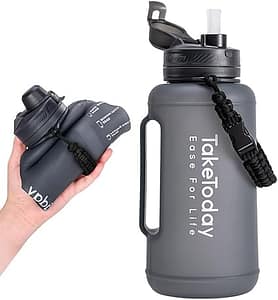
4. Personalize Your Bottle to Reduce Friction
People maintain hydration better with bottles that match their lifestyle:
- If you commute: spill-proof bottle
- If you work at a desk: large bottle with a straw
- If you walk often: lightweight bottle
The less friction, the more consistent the behavior.
5. Use “If–Then Planning” to Automate Hydration
Implementation intention studies show dramatic improvements in habit consistency:
- “If I sit at my desk, then I take a sip.”
- “If I start lunch, then I drink half a glass.”
This method rewires your automatic responses (Holland et al., 2006).
6. Flavor Water Naturally—No Sugary Additives
Flavor makes hydration enjoyable without relying on sugar.
Ideas:
- Lemon + mint
- Cucumber + lime
- Ginger slices
- Herbal teas without sweeteners
This keeps hydration refreshing while supporting metabolic stability.
7. Use Meal Timing to Support Hydration
Drink a glass 10–20 minutes before meals to:
- Improve digestion
- Support appetite regulation
- Avoid mistaking thirst for hunger
Hydration before meals is a subtle but powerful metabolic strategy.
8. Hydrate to Support Mental Performance
Research shows hydration improves:
- Memory recall
- Attention accuracy
- Processing speed
- Emotional stability (Zhang et al., 2021)
If you work with screens, hydration becomes even more important.
9. Eat Hydrating Foods Daily
Foods high in water also support micronutrients important for neurological and immune function.
Excellent options:
- Watermelon, oranges, berries
- Cucumbers, tomatoes, lettuce
- Soups and broths
- Plain yogurt
With these foods, you hydrate without thinking.
10. Adjust Habits by Seasons of Life
Hydration is not static. Needs evolve:
- Kids need structured hydration cues (Trinies et al., 2016)
- Older adults often have reduced thirst awareness
- Active people require hydration pre-, during, and post-exercise
Hydration should adapt as life changes.
When to Seek Medical Support
While hydration is generally safe, it is important to watch for:
- Extremely dark urine
- Persistent dizziness
- Confusion
- Rapid heartbeat
- Very low urine output
These may signal significant dehydration or underlying illness (Cleveland Clinic, 2025).
The Takeaway: Hydration Is a Quiet Daily Discipline That Protects Your Future
You do not need perfection. You need consistency.
Hydration is:
- Cognitive protection
- Emotional grounding
- Metabolic support
- A longevity strategy
Start with one small, repeatable habit today—such as your morning glass or a visible bottle at your desk. Over time, these micro-actions reshape your health in profound ways.
References
Adan, A. (2012). Cognitive performance and dehydration. Journal of the American College of Nutrition, 31(2), 71–78.
Armstrong, L. E., Ganio, M. S., Casa, D. J., et al. (2012). Mild dehydration affects mood in healthy young women. Journal of Nutrition, 142(2), 382–388.
Cleveland Clinic. (2025, March 28). Dehydration and mental health: What’s the connection?
Ganio, M. S., Armstrong, L. E., Casa, D. J., et al. (2011). Mild dehydration impairs cognitive performance and mood of men. British Journal of Nutrition, 106(10), 1535–1543.
Gardner, B. (2023). Developing habit-based health behaviour change interventions. Psychology & Health, 38(5), 601–624.
He, H., Li, X., Lv, Y., et al. (2020). The influence of fluid intake behavior on cognition and mood. Nutrients, 12(5), 1404.
Holland, R. W., Aarts, H., & Langendam, D. (2006). Breaking and creating habits on the working floor: A field-experiment on the power of implementation intentions. Journal of Experimental Social Psychology, 42(6), 776–783.
Institute of Medicine. (2004). Dietary reference intakes for water, potassium, sodium, chloride, and sulfate. National Academies Press.
Kenney, W. L. (2004). Dietary water and sodium requirements for active adults. Gatorade Sports Science Exchange, 92, 1–6.
Kleiner, S. M. (2004). The art and science of hydration. Acta Paediatrica, 93(s445), 11–13.
Masento, N. A., Golightly, M., Field, D. T., Butler, L. T., & van Reekum, C. M. (2014). Effects of hydration status on cognitive performance and mood. British Journal of Nutrition, 111(10), 1841–1852.
Pirolli, P., Mohan, S., Venkatakrishnan, A., Nelson, L., Silva, M., Springer, A., & Ganesan, D. (2017). Implementation intention and reminder effects on behavior change in a mobile health system. Journal of Medical Internet Research, 19(11), e397.
Riebl, S. K., & Davy, B. M. (2013). The hydration equation: Update on water balance and cognitive performance. ACSM’s Health & Fitness Journal, 17(6), 21–28.
Rosinger, A. Y., Lawman, H. G., Akinbami, L. J., & Ogden, C. L. (2016). Daily water intake among U.S. men and women, 2009–2012. NCHS Data Brief, 242, 1–8.
Singh, B., Gardner, B., & West, R. (2024). Time to form a habit: A systematic review and meta-analysis of habit formation in health behaviour. Health Psychology Review, 18(1), 1–25.
Trinies, V., Chard, A. N., Mateo, T., & Freeman, M. C. (2016). Effects of water provision and hydration on cognitive function among primary-school pupils in Zambia: A randomized trial. PLOS ONE, 11(3), e0150071.
van Wesemael, P. J. V., et al. (2019). Living better with water: Identifying design considerations for products aimed at motivating regular water intake. Proceedings of the 2019 CHI Conference on Human Factors in Computing Systems, 1–13.
Zhang, J., Ma, G., Du, S., Liu, S., & Zhang, N. (2021). Effects of water restriction and supplementation on cognitive performances and mood among young adults in Baoding, China: A randomized controlled trial. Nutrients, 13(10), 3645.
Related products
Related posts:
 The Science of Fidgeting: Small Movements That Boost Health
 Cultivating Gratitude Habits to Ease Depression: How Small Acts Can Transform Your Mood
 How a Consistent Sleep Routine Protects Your Mental Health and Helps Prevent Depression
 Moving Against the Blues: How Daily Physical Activity Protects You from Depression