Most of us spend nearly every day in shoes — at home, at work, and even while exercising. While modern footwear protects us from sharp objects and cold ground, it also reduces the natural workload of the feet. Over time, this constant support can weaken muscles, limit sensory input, and change the way we move (Ridge et al., 2013).
Barefoot training — exercising without shoes or in minimalist footwear — is a growing movement that encourages people to reconnect with natural biomechanics. Far from being just a fitness fad, it is supported by science as a way to strengthen the feet, improve balance, enhance posture, and reduce certain injuries (Miller et al., 2014; Lieberman et al., 2010).
Why Your Feet Matter More Than You Think
The human foot is both complex and essential for overall health:
- 26 bones and 33 joints form its structure.
- Over 100 muscles, tendons, and ligaments coordinate movement.
- It acts as a shock absorber, stabilizer, and propulsion system.
When feet are under-stimulated, the entire kinetic chain — from ankles to spine — is affected. Weak feet can contribute to flat arches, poor posture, knee pain, hip misalignment, and even lower back issues (Proske & Gandevia, 2012).
The Science Behind Barefoot Training
1. Foot Muscle Strength and Arch Support
Minimalist or barefoot exercise activates intrinsic foot muscles responsible for arch stability. In a six-month study, participants who trained in minimalist footwear showed increased arch height and muscle size compared to those in traditional shoes (Miller et al., 2014).
2. Sensory Feedback and Proprioception
Feet are loaded with sensory receptors that detect pressure, texture, and position. Cushioned shoes dull this feedback, but barefoot training restores it, leading to better proprioception and reduced risk of sprains (Robbins & Hanna, 1987).
3. Running Mechanics and Impact Forces
Habitually barefoot runners adopt a forefoot or midfoot strike, which lowers the force transmitted through the legs compared to heel striking in cushioned shoes. This adjustment reduces repetitive stress injuries, especially in knees and shins (Lieberman et al., 2010).
4. Posture and Movement Efficiency
Feet act as the body’s foundation. Strengthening them supports better alignment of ankles, knees, hips, and spine. Studies show that improving foot stability enhances overall movement efficiency and reduces compensatory stress throughout the body (Ridge et al., 2013).
5. Aging, Longevity, and Fall Prevention
Falls are a leading cause of injury among older adults. A Cochrane review found that balance and strength programs — including barefoot-style exercises — significantly reduced fall risk (Sherrington et al., 2019). Another study revealed that inability to balance on one leg for 10 seconds was associated with higher mortality rates in older adults (Araújo et al., 2022).
Practical Applications of Barefoot Training
For Beginners
- Walk barefoot indoors on safe surfaces (10–20 minutes daily).
- Practice toe spreads, calf raises, and single-leg stands.
For Fitness Enthusiasts
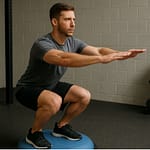
- Perform barefoot squats, lunges, and planks to activate stabilizing muscles.
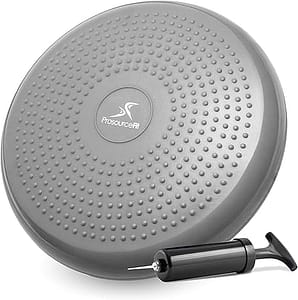
- Add balance drills like heel-to-toe walking or wobble board exercises.
For Runners
- Transition gradually: start with 5–10 minutes of barefoot running on grass, increasing weekly.
- Focus on shorter strides and forefoot landing.
For Older Adults
- Gentle barefoot balance drills (e.g., standing on one leg with support nearby).
- Slow, controlled foot-strengthening movements like toe curls and ankle circles.
Safety Tips
- Transition slowly: Overloading too fast may cause calf or Achilles strain.
- Choose safe surfaces: Grass, mats, or rubber flooring are better than concrete.
- Watch for warning signs: Some soreness is normal, but persistent pain requires rest.
- Seek guidance: People with diabetes or severe flat feet should consult a professional before starting.
Daily Life Integration
Barefoot training is not just for workouts — it can be a lifestyle shift:
- Spend time barefoot at home.
- Opt for minimalist shoes during errands.
- Practice “grounding” outdoors on safe surfaces like grass or sand.
- Add barefoot play for children to support natural arch development.
These small, consistent habits can retrain your feet and improve your overall movement quality.
Conclusion
Barefoot training offers more than just novelty; it is a science-backed practice that restores natural strength, improves posture, and supports lifelong mobility. From athletes looking to boost performance to older adults seeking independence, barefoot training has a role to play.
By starting gradually and focusing on safe, progressive exercises, you can unlock the hidden potential of your feet — transforming not only your workouts but also every step you take in daily life.
References
- Araújo, C. G. S., de Souza e Silva, C. G., Castro, C. L. B., Catai, A. M., & Myers, J. (2022). Association between standing balance and mortality in middle-aged and older adults. British Journal of Sports Medicine, 56(15), 865–871. https://doi.org/10.1136/bjsports-2021-105360
- Lieberman, D. E., Venkadesan, M., Werbel, W. A., Daoud, A. I., D’Andrea, S., Davis, I. S., … Pitsiladis, Y. (2010). Foot strike patterns and collision forces in habitually barefoot versus shod runners. Nature, 463(7280), 531–535. https://doi.org/10.1038/nature08723
- Miller, E. E., Whitcome, K. K., Lieberman, D. E., Norton, H. L., & Dyer, R. E. (2014). The effect of minimal shoes on arch structure and intrinsic foot muscle strength. Journal of Sport and Health Science, 3(2), 74–85. https://doi.org/10.1016/j.jshs.2014.03.011
- Proske, U., & Gandevia, S. C. (2012). The proprioceptive senses: Their roles in signaling body shape, body position and movement, and muscle force. Physiological Reviews, 92(4), 1651–1697. https://doi.org/10.1152/physrev.00048.2011
- Ridge, S. T., Johnson, A. W., Mitchell, U. H., Hunter, I., Robinson, E., Rich, B. S., & Brown, S. D. (2013). Foot bone marrow edema after a 10-week transition to minimalist running shoes. Medicine & Science in Sports & Exercise, 45(7), 1363–1368. https://doi.org/10.1249/MSS.0b013e3182874769
- Robbins, S. E., & Hanna, A. M. (1987). Running-related injury prevention through barefoot adaptations. Medicine & Science in Sports & Exercise, 19(2), 148–156. https://doi.org/10.1249/00005768-198704000-00002
- Sherrington, C., Fairhall, N., Wallbank, G., Tiedemann, A., Michaleff, Z. A., Howard, K., … Clemson, L. (2019). Exercise for preventing falls in older people living in the community. Cochrane Database of Systematic Reviews, 2019(1), CD012424. https://doi.org/10.1002/14651858.CD012424.pub2