When it comes to fitness, most people focus on strength, cardio, or flexibility. Yet, one essential pillar of human movement is often ignored: balance. Balance training is not only for athletes or older adults — it is a science-backed practice that benefits everyone. From preventing falls and injuries to improving posture and enhancing athletic performance, balance is the invisible foundation of all movement.
Despite being overlooked, balance is a key predictor of healthy aging and overall quality of life. A study published in The Lancet found that older adults who had difficulty maintaining balance while walking were significantly more likely to experience falls, a leading cause of injury-related hospitalization (Lundin-Olsson, Nyberg, & Gustafson, 2010).
This article explores what balance training is, the science behind it, and how you can apply simple, effective exercises to improve your stability, coordination, and strength.
What Exactly Is Balance Training?
Balance training involves exercises designed to improve stability, coordination, and control of the body’s position. It challenges the neuromuscular system to maintain posture in static (still) and dynamic (moving) situations (explore next: Dynamic Balance Training: The Hidden Key to Strength and Stability).
Unlike strength training, which often isolates muscles, balance training is holistic: it engages the core, legs, and stabilizing muscles simultaneously, while also involving the brain to process sensory input from the eyes, inner ear, and proprioceptors in muscles and joints (Proske & Gandevia, 2012).
The Science of Balance Training
Neuromuscular Adaptations
Balance training improves proprioception, the body’s ability to sense where it is in space. Research shows this adaptation enhances reflexes, coordination, and agility, reducing injury risks in sports and daily life (Behm et al., 2010).
Strength and Joint Stability
By constantly challenging stabilizer muscles — especially around the ankles, knees, and hips — balance training increases joint stability and lowers the risk of ankle sprains and knee injuries. A meta-analysis found that structured balance programs reduced lower-limb injuries in athletes by up to 36% (Lesinski et al., 2015) (read also: Dynamic Balance Training: The Hidden Key to Strength and Stability).
Cognitive and Brain Health
Emerging evidence suggests that balance training may also improve executive function and dual-task performance, as it requires both physical and mental engagement (Granacher et al., 2011). This makes it particularly beneficial for older adults, where both motor and cognitive decline are risk factors for falls.
Healthy Aging and Longevity
A long-term cohort study revealed that older adults unable to balance on one leg for 10 seconds were at higher risk of mortality over the following decade (Araújo et al., 2022). This highlights balance not just as a fitness skill, but as a biomarker of health and longevity.
Practical Balance Exercises
Balance training can be tailored for all levels — from beginners to athletes (further reading: Dynamic Balance Training: The Hidden Key to Strength and Stability).
Beginner-Friendly
- Single-leg stand: Stand on one leg for 30 seconds, progress by closing your eyes.
- Heel-to-toe walk: Walk in a straight line placing heel against toe each step.
Intermediate
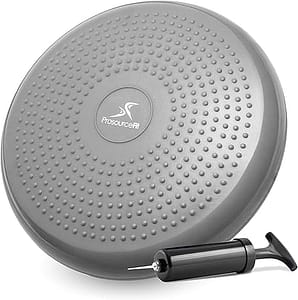
- Balance board drills: Stand on a wobble board or cushion, try gentle squats.
- Dynamic lunges with torso rotation: Lunge forward, then rotate toward the front leg.
Advanced
- Single-leg deadlift: Balance on one leg while hinging forward.
- Bosu ball squats: Perform controlled squats on an unstable surface.
- Sport-specific drills: For athletes, incorporate lateral hops or pivoting while holding balance.
How Often Should You Train Balance?
Experts recommend at least 10–20 minutes, 2–3 times per week, integrated into regular workouts (Sherrington et al., 2019). The key is consistency, not intensity. Pairing balance drills with strength training and mobility work creates a well-rounded routine.
Safety Tips
- Start with stable surfaces and gradually add instability.
- Use a wall or chair for support if needed.
- Progress slowly to avoid unnecessary strain on ankles or knees.
- Always focus on form and posture before adding difficulty.
Beyond Exercise: Daily Balance Challenges
Balance training doesn’t have to happen only in the gym. You can:
- Brush your teeth while standing on one leg.
- Carry groceries in one hand while keeping your core engaged.
- Practice walking sideways or backward in safe spaces.
- Add small “instability moments” to daily life — like standing up without using your hands.
Conclusion
Balance training is not just a niche fitness practice; it is a foundation for long-term mobility, independence, and athletic performance. From preventing falls to improving posture and enhancing brain function, balance is a key investment in lifelong health.
By adding just a few minutes of balance training each week, you can build a stronger core, reduce injuries, and move with more confidence — today and decades from now.
References
- Araújo, C. G. S., de Souza e Silva, C. G., Castro, C. L. B., Catai, A. M., & Myers, J. (2022). Association between standing balance and mortality in middle-aged and older adults. British Journal of Sports Medicine, 56(15), 865–871. https://doi.org/10.1136/bjsports-2021-105360
- Behm, D. G., Drinkwater, E. J., Willardson, J. M., & Cowley, P. M. (2010). Canadian Society for Exercise Physiology position stand: The use of instability to train the core in athletic and nonathletic conditioning. Applied Physiology, Nutrition, and Metabolism, 35(1), 109–112. https://doi.org/10.1139/H09-128
- Granacher, U., Gollhofer, A., & Hortobágyi, T. (2011). The importance of trunk muscle strength for balance, functional performance, and fall prevention in seniors: A systematic review. Sports Medicine, 43(7), 627–641. https://doi.org/10.1007/s40279-011-0097-6
- Lesinski, M., Hortobágyi, T., Muehlbauer, T., Gollhofer, A., & Granacher, U. (2015). Effects of balance training on balance performance in healthy older adults: A systematic review and meta-analysis. Sports Medicine, 45(12), 1721–1738. https://doi.org/10.1007/s40279-015-0375-y
- Lundin-Olsson, L., Nyberg, L., & Gustafson, Y. (2010). “Stops walking when talking” as a predictor of falls in elderly people. The Lancet, 349(9052), 617. https://doi.org/10.1016/S0140-6736(97)24009-2
- Proske, U., & Gandevia, S. C. (2012). The proprioceptive senses: Their roles in signaling body shape, body position and movement, and muscle force. Physiological Reviews, 92(4), 1651–1697. https://doi.org/10.1152/physrev.00048.2011
- Sherrington, C., Fairhall, N., Wallbank, G., Tiedemann, A., Michaleff, Z. A., Howard, K., … Clemson, L. (2019). Exercise for preventing falls in older people living in the community. Cochrane Database of Systematic Reviews, 2019(1), CD012424. https://doi.org/10.1002/14651858.CD012424.pub2