Most people know that exercise is important. The challenge is rarely motivation — it is time. Between work, family, and the demands of daily life, finding a large block of time for the gym feels impossible on most days. But here is what the research consistently shows: you do not need a long session to experience meaningful health benefits from exercise.
A focused, well-designed 10-minute morning workout can improve energy, support metabolism, strengthen your heart, and sharpen your mood — all before the day’s demands have a chance to derail your intentions. The key is making those 10 minutes count.
Why Short, Consistent Exercise Works
The science on short-duration exercise has shifted dramatically in recent years. A landmark review published in The Journal of Physiology demonstrated that low-volume, high-intensity interval training — as few as six sessions totalling roughly 15 minutes of vigorous effort — produced significant improvements in cardiorespiratory fitness, insulin sensitivity, and skeletal muscle metabolic capacity (Gibala et al., 2012). The critical insight: intensity and consistency matter more than duration.
This does not mean every morning session needs to be exhausting. Moderate-intensity movement also delivers genuine benefits. A comprehensive review in the Canadian Medical Association Journal confirmed that regular physical activity — even at lower intensities — substantially reduces the risk of cardiovascular disease, type 2 diabetes, certain cancers, and premature death, while improving mental health and quality of life (Warburton et al., 2006).
The morning timing has additional advantages. Exercise before the day begins eliminates scheduling conflicts, establishes a consistent routine, and provides an immediate mood and energy boost that carries through the first hours of the day.
The 10-Minute Morning Circuit
This routine requires no equipment, no gym, and no more than a small area of floor space. It combines cardiovascular movement with bodyweight strength exercises for a full-body effect in minimal time.
Structure: two rounds of the following five exercises, 45 seconds on and 15 seconds rest between each.
Round 1 and 2:
1. Jumping Jacks (or Step Jacks)
A full-body warm-up that raises heart rate, activates the shoulders, and gets blood flowing to the extremities. Those with joint sensitivity can step side to side instead of jumping, achieving the same cardiovascular effect with less impact.
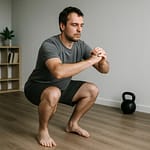
2. Bodyweight Squats
Squats target the glutes, quadriceps, hamstrings, and core simultaneously — more muscle mass than almost any other single movement. Keeping the chest tall, knees tracking over the toes, and weight in the heels ensures proper mechanics. Quality of movement matters more than speed.
3. High Knees
Drive alternate knees toward chest height while pumping the arms. This elevates heart rate rapidly, engages the core, and improves hip flexor mobility. Beginners can perform a brisk march in place to achieve similar benefits at lower intensity.
4. Push-Ups (or Elevated Push-Ups)
Trains the chest, anterior shoulders, triceps, and core in a single movement. Beginners can place hands on a counter or chair to reduce load. The goal is full range of motion: chest close to the floor, arms fully extended at the top, core braced throughout.
5. Plank Hold
Hold a forearm or straight-arm plank for the full 45 seconds, maintaining a straight line from head to heels. This builds deep core stability that transfers to every other movement in the circuit — and to the movements of daily life.
What to Expect After Consistent Practice
In the first week, the primary benefit is momentum — the psychological satisfaction of having done something meaningful before the day began. By week three or four, most people notice improvements in how they feel: more energy in the morning, a subtle improvement in posture, and slightly less fatigue in the afternoons.
Over several months, the cardiovascular and metabolic adaptations described in the research begin to compound. Resting heart rate tends to decrease, energy levels become more stable throughout the day, and the psychological benefits of consistent exercise — reduced anxiety, improved mood, greater resilience — become a reliable part of daily experience.
The Mental Health Case for Morning Movement
Beyond cardiovascular and metabolic benefits, the psychological case for consistent morning movement is equally strong. A meta-analysis published in Health Psychology Review analyzed 49 studies and found that physical activity produced significant reductions in depression and anxiety in non-clinical adult populations — with effects that appeared even in brief, low-to-moderate intensity sessions (Rebar et al., 2015).
What this means practically: the 10 minutes you invest each morning return something measurable before 8 a.m. — a better mood, lower baseline anxiety, and a psychological sense of accomplishment that carries through the rest of the day. Many people find that this early win creates positive momentum: when you have already done something good for your body, you are more inclined to make better choices later in food, attention, and rest.
There is also a deeper dimension to this practice. Taking deliberate care of your body in the first moments of the day is an act of gratitude — an acknowledgment that the body you have been given is worth stewarding well, before the world demands anything from it. Starting from that posture changes not just your physiology, but your orientation toward the whole day.
Making It a Lasting Habit
The research on behavior change is consistent on one point: the easier an action is to initiate, the more likely it is to persist. A few practical strategies to lower the barrier:
- Set your workout clothes out the night before. The small friction of finding clothes is enough to discourage many people. Remove it entirely.
- Do it before checking your phone. The first 20 minutes after waking are psychologically significant — morning routines set in motion before distraction are far more likely to stick.
- Start with two rounds only. The goal in week one is not fitness — it is consistency. Two rounds every morning for seven days builds the habit foundation that everything else rests on.
- Acknowledge each session as a win. Ten minutes of intentional movement is not a compromise — it is a legitimate act of stewardship toward the body you have been given to care for.
Before You Begin
If you are new to exercise, have been sedentary for an extended period, or have any existing cardiovascular, joint, or metabolic health conditions, check with your healthcare provider before starting a new exercise routine. A qualified professional can help you modify the circuit to suit your specific needs and starting point.
Start Tomorrow
The best time to start was years ago. The second best time is tomorrow morning — before you check your phone, before the first demand of the day arrives. Ten minutes. Five movements. Two rounds. That is all it takes to begin.
Consistency, not intensity, is what changes lives. Show up every morning, keep the barrier low, and trust the process. Your body will respond.
References
Gibala, M. J., Little, J. P., Macdonald, M. J., & Hawley, J. A. (2012). Physiological adaptations to low-volume, high-intensity interval training in health and disease. The Journal of Physiology, 590(5), 1077–1084. https://doi.org/10.1113/jphysiol.2011.224725
Warburton, D. E. R., Nicol, C. W., & Bredin, S. S. D. (2006). Health benefits of physical activity: The evidence. CMAJ, 174(6), 801–809. https://doi.org/10.1503/cmaj.051351
Rebar, A. L., Stanton, R., Geard, D., Short, C., Duncan, M. J., & Vandelanotte, C. (2015). A meta-meta-analysis of the effect of physical activity on depression and anxiety in non-clinical adult populations. Health Psychology Review, 9(3), 366–378. https://doi.org/10.1080/17437199.2015.1022901